

What Is Business Development and Why Is It Important for Growth?
Business development is the strategic process of identifying, nurturing, and acquiring new clients and growth opportunities. It is vital for building a strong pipeline, creating lasting relationships, and positioning your business for sustainable revenue increases without over-relying on immediate sales tactics.
When it comes to how to improve business development, Wendell Jean-Jules, founder and CEO of WJJ Brands, builds sustainable growth through personalized coaching, strategic marketing, and digital solutions tailored for service-based businesses. Drawing on over 15 years of experience across finance, healthcare, retail, and hospitality, he transforms challenges into scalable business development opportunities that strengthen brands long-term.
What Does Sustainable Business Growth Really Mean?
Sustainable growth expands revenue while protecting the systems, people, and reputation that support a company. This means focusing on balanced development, leadership capacity, and reliable brand positioning for long-term success rather than short-term revenue spikes.
Sustainable growth demands personalized coaching paired with strategic marketing execution, not one-size-fits-all tactics. With over 15 years of experience across finance, healthcare, retail, hospitality, real estate, and higher education, Wendell Jean-Jules builds tailored business development strategies that turn service-based ventures’ challenges into lasting, resilient opportunities.
Sustainable business growth strategies build resilient, transferable value instead of chasing short-term revenue spikes. Service-based founders and marketing executives gain traction through structured planning, disciplined execution, and consistent monitoring rather than reactive scaling. As RVKS and Associates notes, uncertainty from globalization and technology demands deliberate strategy, Wendell Jean-Jules translates this into coaching that strengthens margins, leadership capacity, and long-term market defensibility.
How Are Business Development and Sales Different?
Business development focuses on creating and nurturing the pipeline of opportunities that fuel growth, while sales focuses on closing those opportunities and generating immediate revenue. Both are crucial but serve distinct roles in a strong growth strategy.
No, business development and sales serve different functions. Business development is the broader process of identifying, nurturing, and acquiring new clients and opportunities that drive long-term growth and profitability. Sales closes the deal; business development builds the pipeline, relationships, and positioning that make closing possible.
What Are Key Traits of Sustainable Growth?
Sustainable growth is characterized by revenue increases with stable or improving profit margins, effective client acquisition systems that avoid founder burnout, responsible resource management, and strong brand positioning to attract new opportunities consistently.
Growth that lasts typically shows up in a few measurable traits:
Revenue increases paired with stable or improving profit margins
Client acquisition systems that do not rely on founder burnout
Responsible management of resources, reputation, and team capacity
Brand positioning strong enough to attract opportunities, not just chase them
How to improve business development starts with this definition, not with chasing every lead that appears.
Why Do Most Growth Strategies Fail?
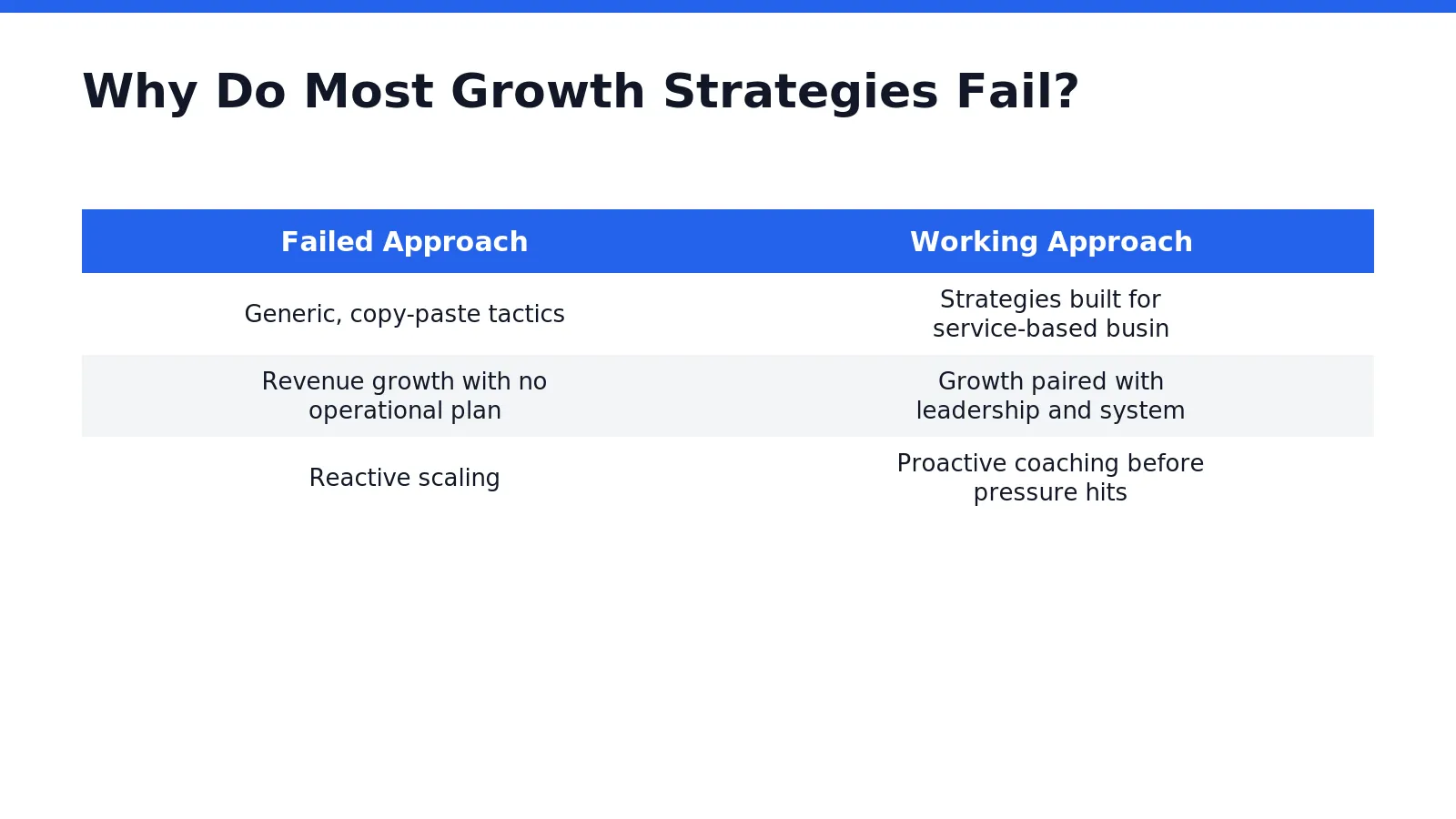
Many growth strategies fail because they chase revenue without a strong operational and leadership framework. Rapid scaling without systems in place leads to management breakdowns, margin erosion, and risk amplification, especially in service-based businesses.
Growth strategies collapse when owners chase revenue without a structural plan. 7 Sustainable Business Growth Strategies notes that not all growth qualifies as good growth. For capital-intensive, family-owned businesses, chasing top-line numbers without a plan erodes margins, strains leadership, and adds risk. That pattern repeats across service-based businesses that scale marketing spend before building the systems to support it.
Leadership capacity often lags behind ambition. Once growth outruns what leaders can manage, performance wobbles and operations start to slip. Building a stronger bench before demand hits reduces that risk considerably.
Wendell Jean-Jules built his practice around solving exactly this gap. He embodies resilience and a steady commitment to helping entrepreneurs turn setbacks into opportunity, rather than letting one bad quarter stall momentum. His approach to improving business development centers on tailored strategy, not templates.
What separates a failed strategy from a working one?
Why Does Leadership Capacity Matter So Much?
Leadership capacity is crucial because it controls whether growth strengthens or stresses a business. Without leaders ready to manage new demands, even strong revenue growth can create operational instability and threaten long-term success.
Capacity determines whether growth strengthens a business or breaks it. Without leaders ready to manage expansion, even strong revenue gains create instability behind the scenes.

How Can You Structure Business Development for Growth?
Structured business development involves creating repeatable systems for client acquisition, brand positioning, and marketing consistency. By combining personalized coaching with targeted marketing strategies, businesses foster steady, sustainable growth instead of relying on accidental opportunities.
Growth accelerates when business development becomes structured, not accidental. Wendell Jean-Jules, a marketing executive and brand strategist with over 15 years of experience, guides business owners through the process of strengthening their brands and refining marketing strategy for sustainable growth. His coaching draws on work across finance, healthcare, retail, hospitality, real estate, higher education, and professional services, giving service-based owners a cross-industry lens on what actually moves the needle.
Improving business development starts with a clear framework rather than scattered tactics. Owners who build systems around client acquisition, brand positioning, and marketing consistency see steadier results than those chasing quick wins.
What Does Effective Business Development Actually Require?
Effective business development requires a defined brand identity, marketing systems that deliver consistent and qualified leads, and coaching that helps turn setbacks into strategic pivots for ongoing growth.
Effective business development requires tailored strategy, not generic templates. Wendell Jean-Jules crafts and implements growth plans built specifically for service-based business owners, combining personalized coaching with strategic marketing expertise so ventures grow with intention.
Three elements matter most:
A defined brand identity that separates the business from competitors
Marketing systems that generate consistent, qualified leads
Coaching support that turns setbacks into strategic pivots
What Are the Pipeline Stages in Business Development?
What Are Typical Conversion Benchmarks in Business Development?
How to Source Strategic Partnerships for Growth
Strategic partnerships multiply growth opportunities by leveraging complementary strengths, networks, and resources. Effective sourcing involves identifying potential partners with aligned values, customer bases, and capabilities to create mutually beneficial relationships.
Start by mapping your ecosystem to spot gaps your partners can fill and opportunities where combined offerings drive enhanced value. Utilize industry events, professional networks, and digital platforms to proactively seek and evaluate candidates. Prioritize collaborations that offer clear win-win scenarios rather than opportunistic deals.
How to Architect Deal Negotiations for Successful Partnerships
Deal negotiation architecture is essential to establish clear terms, expectations, and accountability. Designing a structured negotiation process maintains focus on shared goals and long-term success.
Establish transparent frameworks covering revenue sharing, responsibilities, intellectual property, confidentiality, and exit clauses. Incorporate flexibility for adapting terms as the partnership evolves. Engage legal counsel early to mitigate risks and ensure alignment with business objectives. Successful deal architecture balances ambition with pragmatism, nurturing trust while protecting interests.
What Is Partner Enablement and Why Does It Matter?
Partner enablement equips your collaborators with the knowledge, tools, and support needed to effectively represent and sell your offerings. Investing in enablement accelerates co-selling success and strengthens the partnership’s impact.
Enablement includes training on products and services, joint marketing materials, access to sales support, and shared metrics. Regular communication and feedback loops help refine approaches and address challenges promptly. Effective enablement turns partners into brand advocates and revenue generators, creating a scalable engine for growth.
How to Build and Optimize Outbound Relationship Funnels
Outbound relationship funnels systematically engage target prospects and partners through personalized outreach across channels such as email, social media, and events.
Effective funnels segment audiences, tailor messaging to their needs and pain points, and nurture engagement with relevant content and value propositions. Tracking interactions and conversion metrics enables continuous refinement of tactics and timing. Building outbound funnels extends reach beyond inbound channels and creates reliable pipelines for business development.
What Are Co-Marketing Strategies That Accelerate Growth?
Co-marketing leverages partnerships to jointly promote complementary products or services, expanding visibility and credibility.
Successful co-marketing initiatives include joint webinars, content collaborations like blogs and whitepapers, shared advertising campaigns, social media amplification, and cross-promotions. Aligning messaging and target audiences maximizes impact. Monitoring performance metrics ensures the partnership drives measurable results. Co-marketing strengthens brand positioning and opens new channels for lead generation.
How to Optimize Pipeline Velocity for Business Development
Pipeline velocity measures the speed at which prospects move through the development stages towards closing deals. Faster velocity means quicker revenue realization and efficient resource use.
Optimizing pipeline velocity requires clear qualification criteria, prompt follow-up processes, and alignment between marketing and sales activities. Removing bottlenecks through automation, standardized proposal templates, and scheduled check-ins accelerates progress. Regular pipeline reviews and forecasting enable proactive course correction, improving conversion rates and deal cycle times.
What Is Ecosystem Building and How Does It Impact Growth?
Ecosystem building involves creating networks of interconnected partners, customers, and stakeholders that generate collective value and innovation.
A robust ecosystem enhances customer experiences through integrated solutions, expands market reach via referrals and collaborations, and fosters learning and development. Nurturing ecosystems requires ongoing communication, shared vision, and mechanisms for co-creation. Ecosystems evolve into competitive advantages by creating entry barriers and diffusing risks among participants.
Business Development Channel Comparison Matrix
Where Does the Elise Legacy Program Fit in Improving Business Development?
The Elise Legacy Program provides a structured, recurring coaching pathway designed to help business owners commit to long-term, sustainable growth. Starting with a complimentary session, it guides founders through refining business development strategies to build resilient brands.
The Elise Legacy Program serves as a recurring, structured pathway for owners committed to long-term growth. Wendell Jean-Jules delivers this offering with professionalism and care, reinforcing trust as clients implement new practices. Business owners exploring this path can start with a Complimentary Zoom Session to map their next move.
Conclusion
In closing, sustainable business growth demands a strategic foundation built on intentional planning, authentic relationships, and continuous refinement. By aligning your marketing efforts with clear business objectives, you position your venture for long-term success rather than fleeting gains. The path forward requires commitment to understanding your market, serving your clients with excellence, and adapting your approach as circumstances evolve. Your growth journey transforms when strategy meets execution, turning vision into measurable results that strengthen your brand and expand your impact.